

Learning how to do some simple exercises can help your recovery after breast cancer surgery. These moves can gradually improve the movement range of your arm and shoulder. They can also ease tightness and help get you back to your usual activities.
Always consult your doctor about matters that affect your health. This information is intended as a general introduction and is not a substitute for professional medical advice.
Learn more about:
Before you begin
A physiotherapist or exercise physiologist can help you with exercises after surgery, and you can try these exercises at home on your own. Follow the below instructions if you are doing these moves on your own.
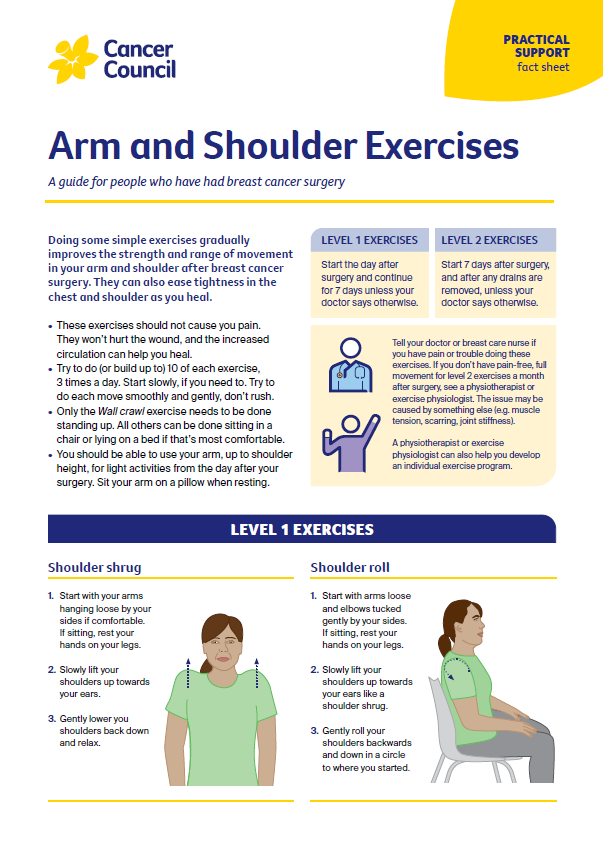
- These exercises should not cause you pain. They won’t hurt the wound, and the increased circulation can help you heal.
- Try to do (or build up to) 10 of each exercise, 3 times a day. Start slowly, if you need to. Try to do each move smoothly and gently, don’t rush.
- Only the Wall crawl exercise needs to be done standing up. All others can be done sitting in a chair or lying on a bed if that’s most comfortable.
- You should be able to use your arm, up to shoulder height, for light activities from the day after your surgery. Sit your arm on a pillow when resting.
| Level 1 Exercises | Start the day after surgery and continue for 7 days unless your doctor says otherwise. |
| Level 2 Exercises | Start 7 days after surgery, and after any drains are removed, unless your doctor says otherwise. |
When to move on to other exercises
After completing level 1 and 2 exercises, talk to your doctor or a qualified physiotherapist about when it is safe for you to begin other types of exercise, such as cardio and strength-training. Once you have been told it’s okay to move on from these arm and shoulder exercises, you can check out the rest of our exercise section. It has more information about exercise for people affected by cancer and has step-by-step instructions for moves you can try at home.
Tell your doctor or breast care nurse if you have pain or trouble doing these exercises. If you don’t have pain-free, full movement for level 2 exercises a month after surgery, see a physiotherapist or exercise physiologist. The issue may be caused by something else (e.g. muscle tension, scarring, joint stiffness).
A physiotherapist or exercise physiologist can also help you develop an individual exercise program.
→ READ MORE: Level one exercises
Key resource
Download a PDF booklet on this topic.
More resources

This information has been developed by Cancer Council NSW using information from the Cancer Council Australia Understanding Cancer series and Cancer Council SA Breast cancer surgery: Information for women having breast cancer surgery as source material.
We thank the reviewers of this fact sheet: Jen McKenzie, Lymphoedema Physiotherapist, ESSA Accredited Exercise Physiologist, Director at The McKenzie Clinic, QLD; Sharon Dreise, Consumer; Prof Elisabeth Elder, Specialist Breast Surgeon, Westmead Breast Cancer Institute, University of Sydney, NSW; Eliza Macdonald, Accredited Exercise Physiologist, Sydney Cancer Survivorship Centre, Concord Repatriation General Hospital, NSW; Annmaree Mitchell, Consumer; Chris Rivett, 13 11 20 Consultant, Cancer Council SA.
View the Cancer Council NSW editorial policy.